Best Electric Pressure Washer for Cars (Under $200)
Last updated August 5, 2026 · By Mike Turner — reviewed hands-on
Disclosure: Some links below are affiliate links. If you buy through them, we may earn a small
commission at no extra cost to you. As an Amazon Associate, we earn from qualifying purchases. We only
recommend gear we'd actually put in a beginner's hands.
More pressure isn't automatically better for washing a car — too much PSI at close range can chip paint
edges or force water past trim seals, which is the opposite of what you're trying to accomplish. What
actually matters for car washing is a safe, controllable PSI range, decent flow rate (GPM) if you want to
run a foam cannon, and a machine that doesn't die after a season of driveway use.
Quick answer: the Sun Joe SPX3000 is the pick we'd recommend to most people under $200 — widely
used specifically for car washing, with a PSI range that's genuinely safe with correct technique. If you
want to spend a bit more for noticeably better build quality, the Karcher K5 is worth it.
What actually matters for washing a car (not a driveway)
PSI (pounds per square inch). More isn't better here. For car washing, roughly 1,200-1,900 PSI is
the safe, effective range with correct technique and distance. Machines rated well above 2,000+ PSI are
built more for driveways and decks — usable on a car with extra caution and distance, but not the ideal
tool for the job.
GPM (gallons per minute). This matters more than PSI if you plan to run a foam cannon — foam cannons
need adequate flow to produce thick foam, and a higher GPM rating generally produces better foam output at
a given PSI. Check your foam cannon's minimum GPM requirement against a washer's spec before assuming any
electric pressure washer will pair well with one.
Detergent tank or injector. Useful for applying pre-wash soap through the washer itself, though a
separate foam cannon attachment (see
Best Foam Cannon for Beginners) generally produces better foam
than a built-in tank alone.
Nozzle options. A wide-fan nozzle (25-40 degrees) is the safer choice for paint; avoid the narrow
0-degree “pencil jet” nozzle on paint entirely — that concentrated stream is what actually causes chipping
at close range, regardless of the machine's overall PSI rating.
The best electric pressure washers for cars under $200
Best overall — Sun Joe SPX3000
The SPX3000 has become something of a default recommendation in the detailing community specifically
because it hits a safe, effective PSI range for cars while staying affordable and widely available. It's
not the most refined machine on this list, but it does the job reliably.
- Best for: most people washing one or two vehicles regularly
- Why it wins: a PSI range well-suited to cars, good GPM for foam cannon use, and a large installed
base of detailer feedback to draw on. - Watch-outs: build quality is “good for the price,” not premium — treat it accordingly and don't
expect it to last as long as a step-up machine under heavy commercial-style use.
The SPX3000's large installed base among detailers means its strengths and quirks are well documented —
adequate GPM for foam cannon use and a PSI range that stays safe for cars is the consistent takeaway across
long-term owner feedback.
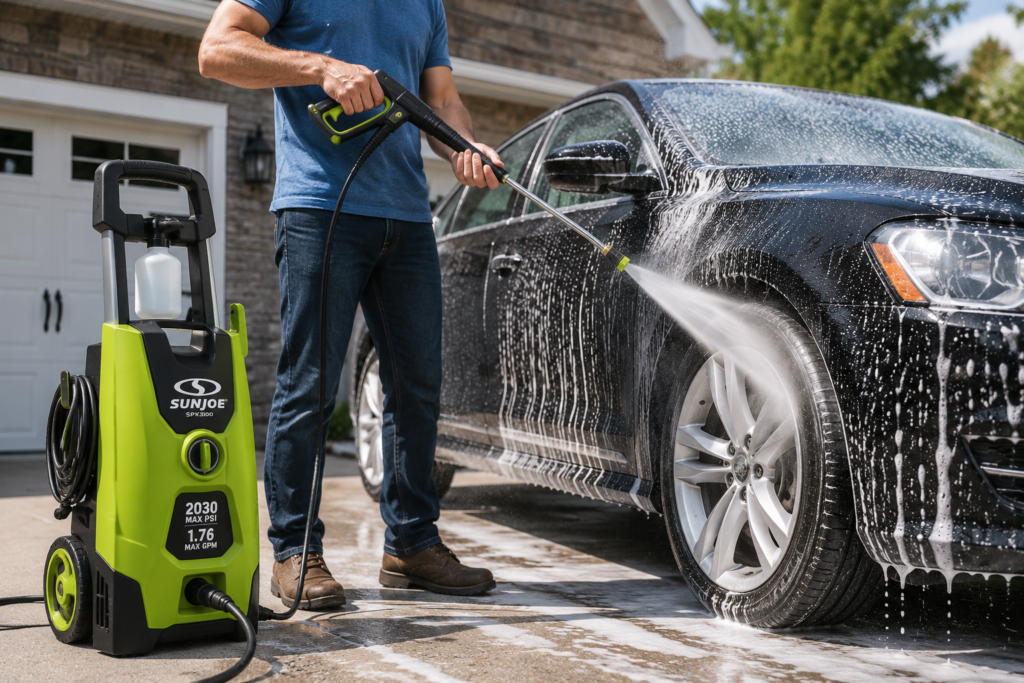
👉 Check current price: Sun Joe SPX3000
Best build quality — Karcher K5
Karcher has a long reputation specifically in pressure washing, and the K5 reflects that — noticeably more
refined construction and consistent performance than most machines in this price range, even when it lands
right at or slightly above $200 depending on the current bundle.
- Best for: buyers who want to pay a bit more for durability and refinement
- Why it wins: consistent, reliable performance and a brand with real pressure-washing pedigree, not
just a rebadged generic unit. - Watch-outs: verify current price — some K5 bundles land just over the $200 mark depending on included
accessories.
Karcher's reputation in this category isn't marketing — long-term owners consistently report more
consistent pressure and fewer reliability issues over years of use compared to generic-brand alternatives.
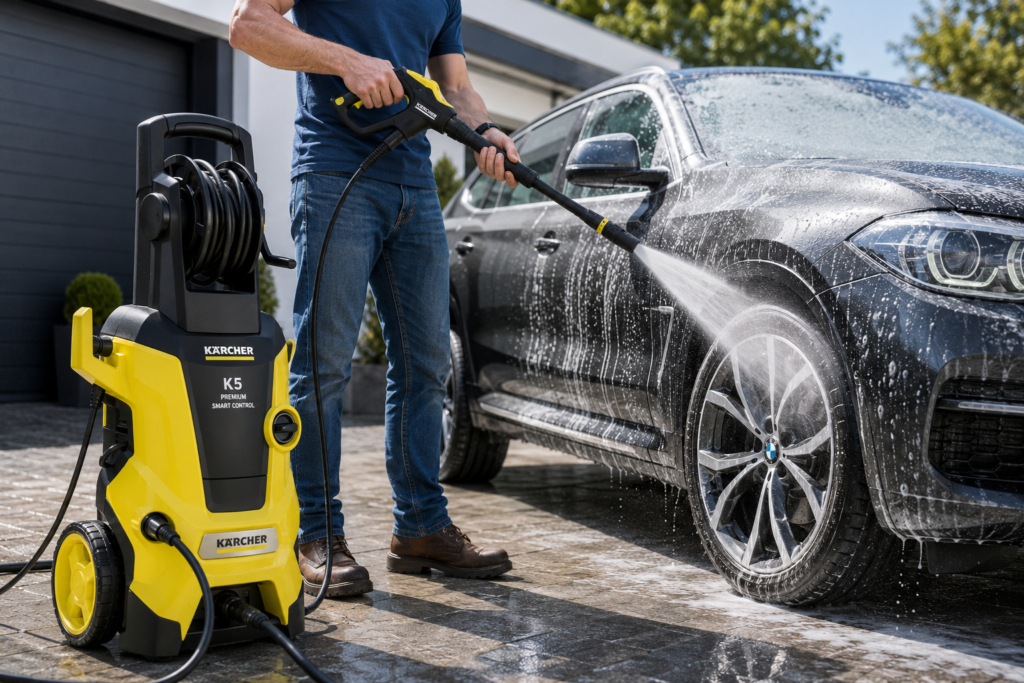
👉 Check current price: Karcher K5
Best budget — AR Blue Clean AR383
A genuinely capable entry-level electric pressure washer at a lower price than the SPX3000, if you want to
spend as little as possible to get started.
- Best for: the tightest budget that still gets real results
- Why it wins: functional PSI range for cars at a lower price point than most named-brand alternatives.
- Watch-outs: expect a shorter hose and less refined build than the pricier picks — fine for occasional
use, less ideal if you're washing multiple vehicles weekly.
At this price, reviewers consistently frame it as the sensible floor — functional PSI for cars, without
expecting the hose length or refinement of a step-up machine.
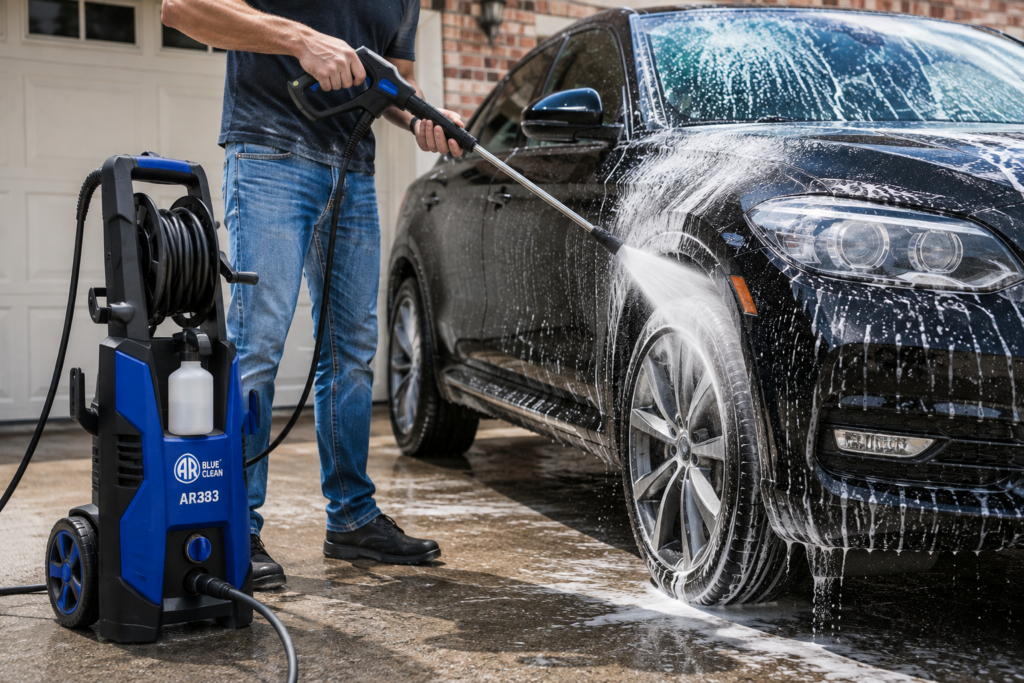
👉 Check current price: AR Blue Clean AR383
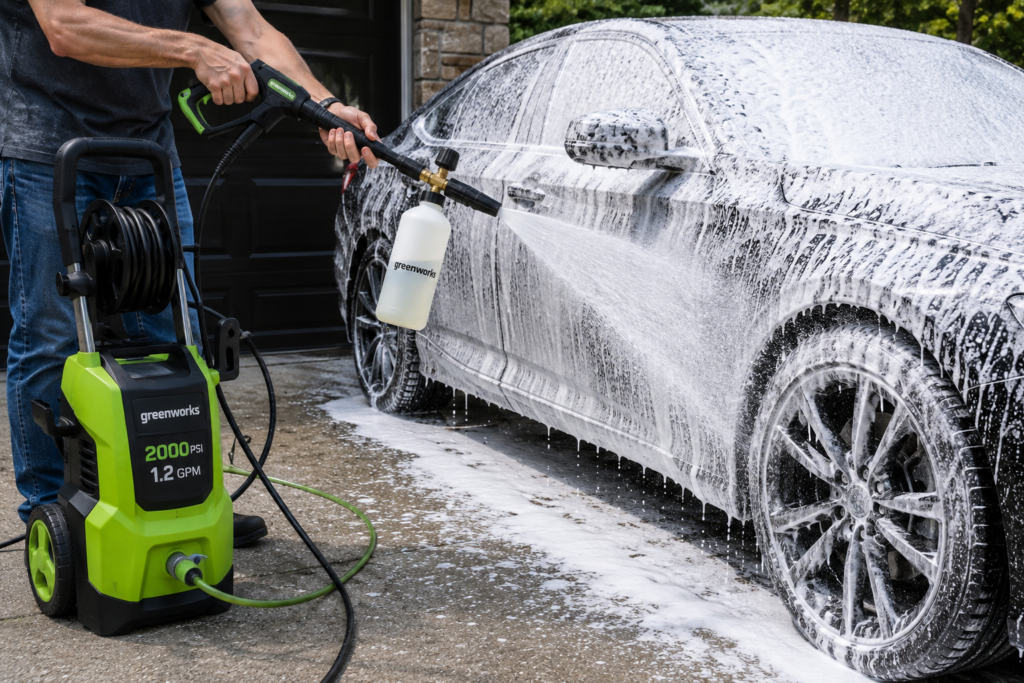
Best GPM for foam cannon use — Greenworks GPW2000
If pairing with a foam cannon for real snow-foam results is your priority, the Greenworks line tends to
offer a favorable GPM relative to its price, which translates directly into thicker, more consistent foam
output.
- Best for: foam cannon pairing as the primary use case
- Why it wins: flow rate that plays well with foam cannon requirements without needing to step up to a
gas unit. - Watch-outs: verify the specific model's current GPM rating against your foam cannon's minimum
requirement before buying either.
Buyers pairing this specifically with a foam cannon consistently note thicker, more consistent foam output
than lower-GPM machines at a similar price — exactly the tradeoff this pick is built around.
👉 Check current price: Greenworks GPW2000
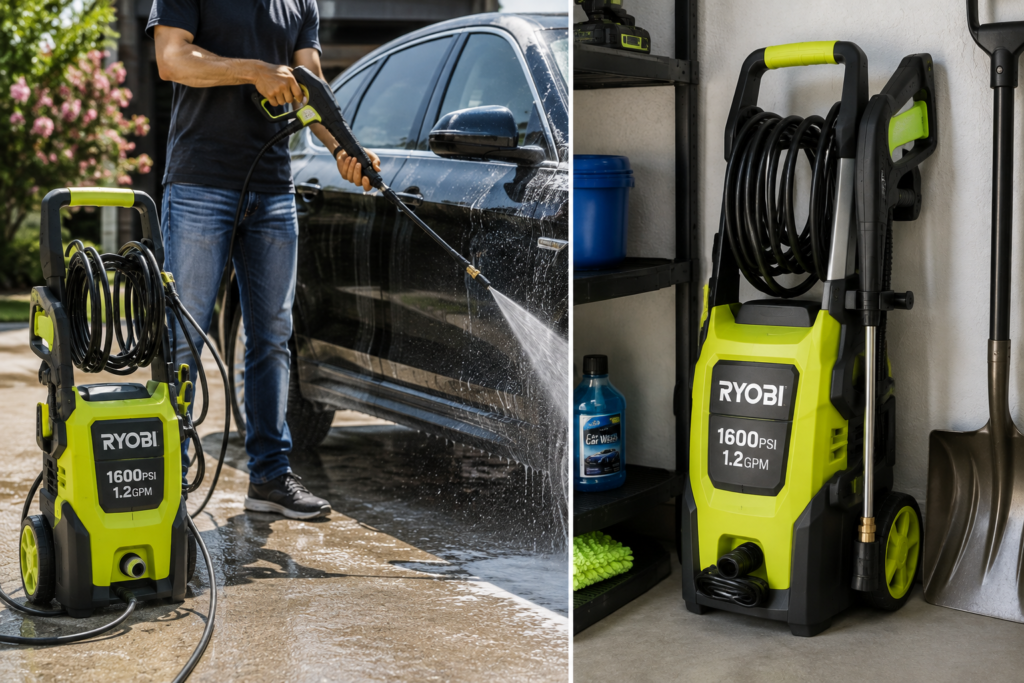
Best compact option — Ryobi 1600 PSI Electric Pressure Washer
If garage or storage space is tight, this is a noticeably more compact unit than most of the others here,
without giving up a usable PSI range for cars.
- Best for: limited storage space, apartment or condo garages
- Why it wins: smaller footprint without sacrificing the core safe-PSI-for-cars requirement.
- Watch-outs: lower PSI ceiling than some competitors — fine for cars specifically, less versatile if
you also want to use it for heavier driveway or deck cleaning.
Reviewers in apartments and condos with limited garage space consistently cite the compact footprint as
the reason they picked this over a larger-PSI competitor — for washing a car specifically, the lower
ceiling isn't a real limitation.
👉 Check current price: Ryobi 1600 PSI Electric Pressure Washer
Comparison at a glance
| Model | PSI range | Best for | Price tier |
|---|---|---|---|
| Sun Joe SPX3000 | ~2,030 (usable range for cars with distance/nozzle choice) | Best overall | $$ |
| Karcher K5 | Refined, consistent | Best build quality | $$$ |
| AR Blue Clean AR383 | Entry-level safe range | Best budget | $ |
| Greenworks GPW2000 | Favorable GPM | Foam cannon pairing | $$ |
| Ryobi 1600 PSI | Lower ceiling, car-appropriate | Best compact | $$ |
Verify current PSI/GPM specs and prices before publishing — these change across model revisions more than
most detailing gear.
How to use a pressure washer on a car safely
- Use a wide-fan nozzle (25-40°), never the narrow pencil-jet tip, anywhere near paint.
- Keep the wand at least 12-18 inches from the surface, closer only for stubborn spots on wheels or
tires, never on paint. - Work top to bottom, same order as any wash, rinsing loose dirt before contact washing.
- Never point it directly at seals, badges edges, or trim gaps at close range — that's how water gets
forced past weatherstripping. - Use it for pre-rinse and foam cannon operation, not as a substitute for the two-bucket contact wash —
see Two-Bucket Wash Method Explained.
Caring for an electric pressure washer
- Never let it run dry. Running the pump without a water supply connected, even briefly, can damage the
pump seals — always confirm the hose is connected and flowing before starting the unit. - Store it freeze-protected. Any water left in the pump or hose can freeze and crack components — drain
and disconnect hoses before freezing temperatures if you're storing it somewhere unheated. - Flush the detergent tank after use if you used one, so dried soap doesn't clog the injector for next
time. - Check and replace the inlet filter screen periodically — a clogged screen restricts flow and can
cause the motor to work harder than it needs to.
Extension cords and electrical safety
Electric pressure washers draw meaningful current, and using an undersized extension cord is a common way
people damage the motor or trip breakers repeatedly. If you need an extension cord to reach your washing
spot, use a 12-gauge, outdoor-rated cord rated for the washer's amperage, kept as short as practically
possible — longer or thinner cords cause voltage drop that stresses the motor. Also confirm you're plugged
into a GFCI-protected outlet, standard practice anytime you're combining electricity and water outdoors.
What else you need
A pressure washer is one piece of the washing setup, not the whole thing:
- A foam cannon to actually use that pressure for pre-wash foam:
Best Foam Cannon for Beginners - The two-bucket method for the contact wash itself:
Two-Bucket Wash Method Explained - The rest of a starter kit:
Beginner Car Detailing Kit: What to Include (3 Budgets)
Mistakes that cause damage with a pressure washer
- Using the narrow pencil-jet nozzle on paint. This is the single most common cause of pressure-washer
paint damage — always use a wide fan setting on paint. - Getting too close. High PSI concentrated at close range can chip paint at edges and force water past
seals, even with a wide nozzle. - Buying based on PSI number alone. A higher-PSI machine isn't automatically better for cars — the
1,200-1,900 range is the sweet spot, and going well beyond it adds risk without adding benefit for this
specific use case. - Ignoring GPM if you want a foam cannon. A high-PSI, low-GPM machine can still produce weak, thin foam
— check both specs, not just PSI, if pre-foaming matters to you.
FAQ
What PSI is safe for washing a car?
Roughly 1,200-1,900 PSI is the generally accepted safe, effective range for car washing with correct
technique (wide nozzle, adequate distance). Higher-PSI machines can still be used carefully but aren't
necessary or ideal for this specific job.
Do I need a gas pressure washer, or is electric enough for a car?
Electric is genuinely enough for car washing — gas units are built for heavier, larger-scale cleaning
(driveways, siding) and are overkill, louder, and more maintenance-intensive for washing one or two
vehicles.
Can a pressure washer strip wax or sealant off my car?
A properly diluted pre-rinse and foam step shouldn't meaningfully strip protection, but repeated
close-range, high-pressure blasting at the same spot can accelerate wear on wax specifically. Keep
technique correct and it's not a significant concern.
What nozzle degree should I use on my car?
A 25-40 degree wide-fan nozzle. Never use a 0-degree pencil-jet nozzle on paint — that's the setting most
associated with actual damage.
Is a more expensive pressure washer worth it if I'm only washing one car?
Not necessarily — the Sun Joe SPX3000 or AR Blue Clean cover the core need well for occasional single-car
use. The step up to something like the Karcher K5 pays off more clearly if you're washing multiple vehicles
or using it very regularly.
The bottom line
For most people, the Sun Joe SPX3000 covers the real requirements — safe PSI range for cars, enough
GPM for a foam cannon, and a track record in the detailing community. Step up to the Karcher K5 if
build quality and longevity matter more to you than price, or go with the AR Blue Clean if you just
want the lowest-cost legitimate entry point. Whatever you buy, nozzle choice and distance matter more to
your paint's safety than the PSI number on the box.
New to washing correctly? See
Two-Bucket Wash Method Explained or start from the beginning
at Car Detailing for Beginners: Where to Start.