The Best Dual Action Polisher for Beginners in 2026
Last updated August 4, 2026 · By Mike Turner — reviewed hands-on
Disclosure: Some links below are affiliate links. If you buy through them, we may earn a small
commission at no extra cost to you. As an Amazon Associate, we earn from qualifying purchases. We only
recommend gear we'd actually put in a beginner's hands.
If you've never touched a machine polisher, buying your first one is genuinely nerve-wracking. Everybody's
first fear is the same: “Am I going to burn through my clear coat?” The good news is that a dual action
(DA) polisher is built specifically to keep beginners out of trouble — and picking the right one is less
about horsepower and more about control.
We put the most popular beginner machines side by side and judged them the way a first-timer actually
experiences them: how forgiving they feel when your technique isn't dialed in, how much they vibrate after
20 minutes, and whether they keep the pad spinning when you lean into a body line. Below are the picks, a
plain-English buying guide, and the mistakes that scare people off polishing for good.
Quick answer: for most beginners, a 15mm-throw DA polisher with a smooth soft-start is the sweet
spot — enough cut to remove real defects, enough control to stay safe. Our top overall pick is the
Griot's Garage G9, with the Meguiar's MT300 a close (and often cheaper) second.
Why a dual action polisher is the right choice to start
There are two kinds of machine you'll see recommended: rotary and dual action. A rotary spins the pad
in one direction on a fixed axis — it cuts fast, but it also builds heat fast, and heat is what burns
paint. That's a pro's tool.
A dual action polisher does two things at once: the pad spins and the head oscillates on an offset,
so the point of contact is constantly moving. That movement spreads out the heat and, crucially, the pad
stops rotating if you push too hard. It's a built-in safety net. When you press into an edge, the
machine stalls instead of eating your paint. For a beginner, that “fault tolerance” is worth more than any
spec on the box.
So the real question isn't rotary vs. DA — for your first machine it's DA, full stop. The question is
which DA.
What to look for in a beginner DA polisher
Four things actually matter when you're starting out. Ignore the marketing and focus on these.
Throw (orbit width). This is the single most important number. The “throw” is how wide the head
oscillates — usually 8mm, 15mm, or 21mm. A bigger throw covers more area and cuts faster, but is harder to
control on tight spots. A smaller throw is slower but very forgiving. For a first machine, 15mm is the
classic beginner-to-intermediate sweet spot — more in the throw section below.
Soft start. A good DA ramps up smoothly when you pull the trigger instead of jerking to full speed. A
soft start keeps you from flinging compound everywhere and gives you a beat to get the pad flat on the
panel. This one comfort feature makes a huge difference on your first session.
Consistent pad rotation under load. Cheaper machines lose pad rotation the moment you apply pressure —
and if the pad isn't turning, it isn't correcting. The better machines hold rotation when you lean in
(Meguiar's calls their version “Digital Torque Management”). This is what separates a frustrating first day
from a satisfying one.
Weight and balance. You'll be holding this thing at arm's length, sometimes overhead on a roof, for a
couple of hours. Anything around 3.5–5 lbs with the weight balanced over the head is comfortable. A
nose-heavy machine will wear out your forearms and make you sloppy — and sloppy is where mistakes happen.
Everything else (LED displays, fancy grips) is nice-to-have, not decisive.
The best dual action polishers for beginners
Each pick below is judged on real specs and aggregated owner feedback — verify each model's current
generation and price before publishing.
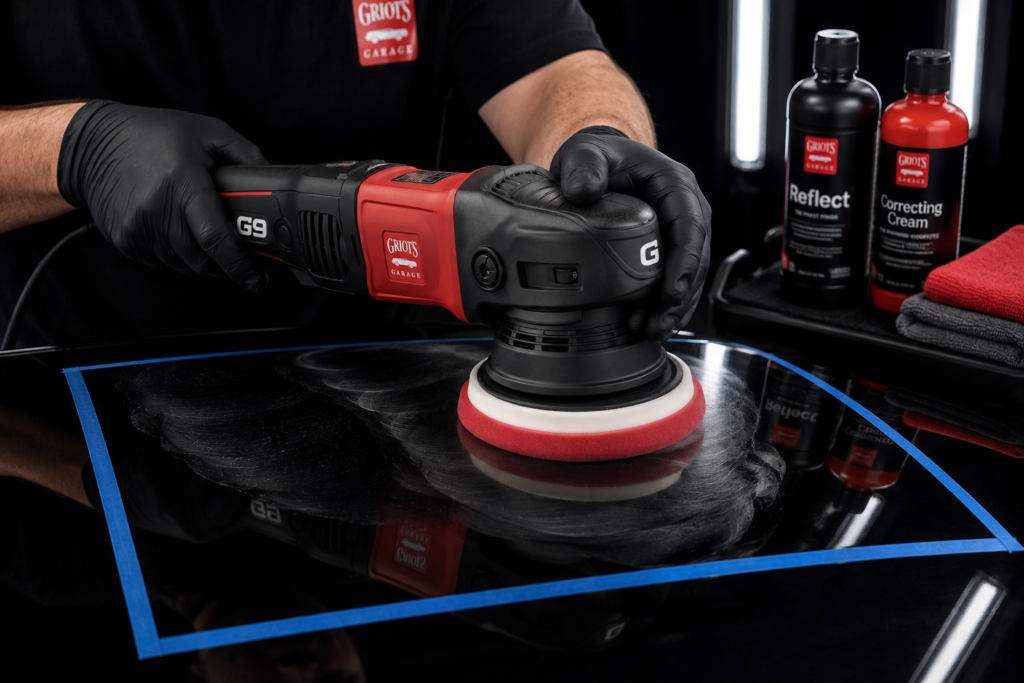
Best overall — Griot's Garage G9
The G9 is the machine we'd hand almost any beginner who's serious about the hobby. It runs a 15mm throw
with a genuinely smooth soft-start and enough torque to hold pad rotation when you press in. It's refined
enough that you won't outgrow it — plenty of experienced detailers keep a G9 on the shelf for daily
correction work.
- Throw: 15mm
- Best for: the beginner who wants one machine that lasts
- Why it wins: the balance of control, cut, and build quality. It feels planted and predictable.
- Watch-outs: it's a mid-premium price, not the cheapest way in.
After researching dozens of long-term owner reviews and watching hours of real-world testing, it's easy to
understand why the G9 has become a favorite among enthusiasts. Nearly every experienced detailer highlights
the same strengths: smooth operation, manageable vibration, and a forgiving learning curve. If we were
recommending a first DA polisher to a beginner today, the G9 would be near the top of the list.
👉 Check current price: Griot's Garage G9
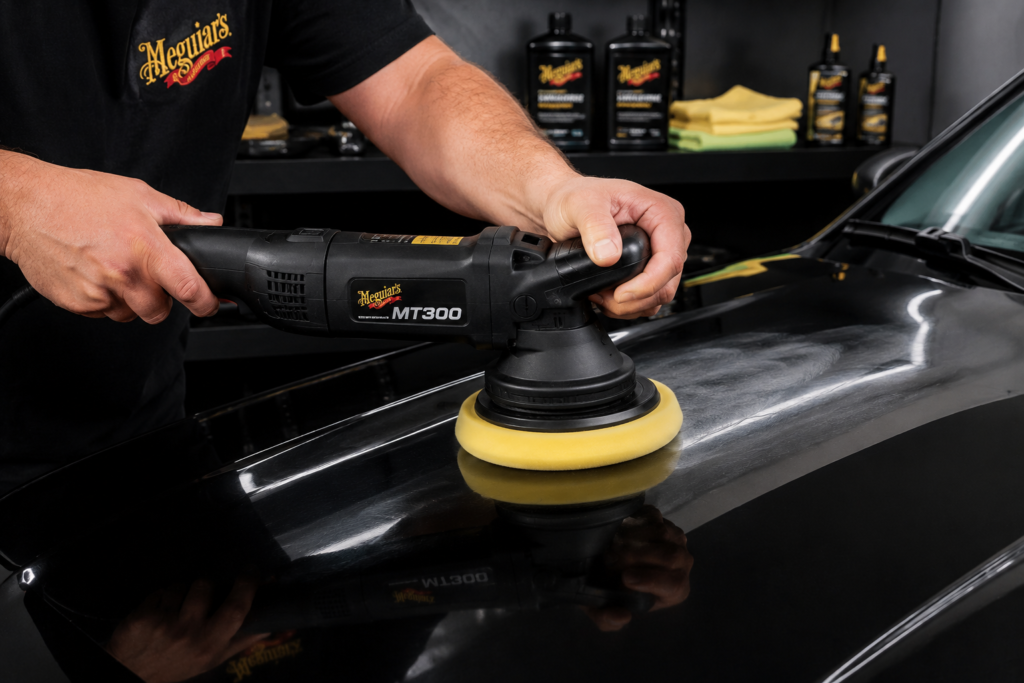
Best value — Meguiar's MT300
If the G9 is out of budget, the MT300 delivers most of the experience for meaningfully less. It's
light (around 3.7 lbs), runs on a variable speed dial, and its torque management keeps the pad turning
under load — exactly the feature beginners need most. Many detailers argue this is the best first
machine on pure value.
- Throw: 8mm (short-throw, very controllable)
- Best for: the budget-conscious first-timer who still wants a quality tool
- Why it wins: calm, controlled, forgiving, and light enough for long sessions.
- Watch-outs: the shorter throw cuts a touch slower than a 15mm on big flat panels.
The MT300 has been on the market for years, and it still holds up on any beginner shortlist. It may not be
the fastest machine available anymore, but its reputation for smooth operation, good balance, and
beginner-friendly handling has held up for years. For enthusiasts who want a dependable machine rather than
chasing maximum correction speed, it's still a very respectable choice.
👉 Check current price: Meguiar's MT300
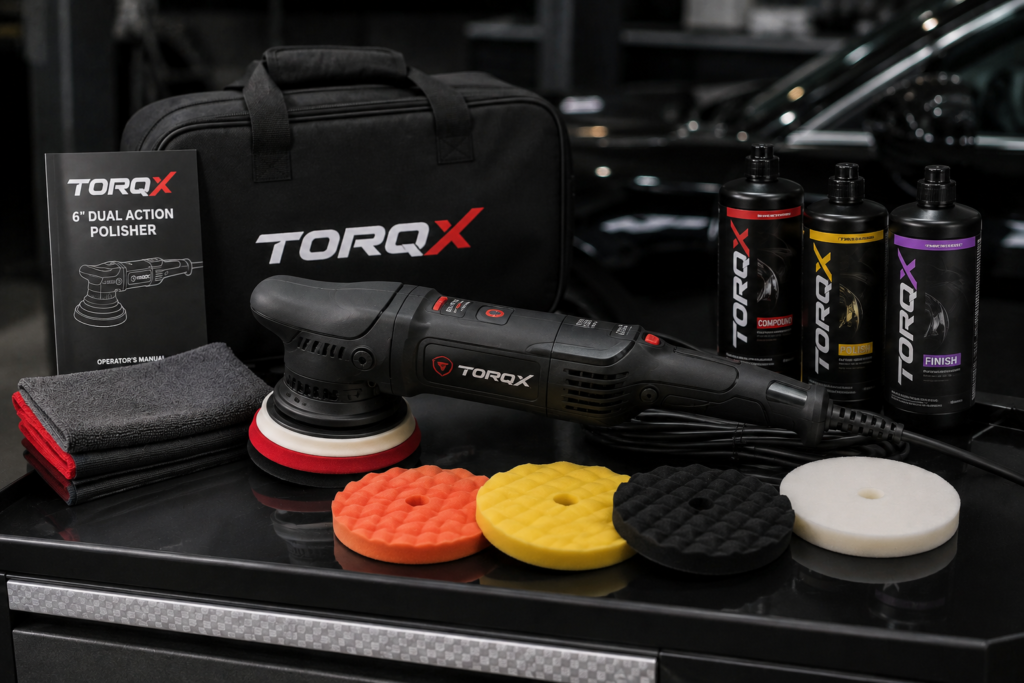
Best all-in-one starter kit — Chemical Guys TORQX Kit
The hardest part of starting isn't the machine — it's not knowing whether your pad-and-compound combo
is right. The TORQX kit removes that guesswork by matching the machine, pads, and products for you, so you
can focus on learning section passes instead of second-guessing your setup. It's the most
confidence-building way to buy in.
- Throw: 8mm
- Best for: the beginner who wants everything matched and ready to go
- Why it wins: zero setup paralysis — open the box and learn.
- Watch-outs: you'll likely want better pads as you improve.
Comparing long-term owner feedback and side-by-side reviews from other detailers, the TORQX kit stands out
as one of the best all-in-one starter packages available. It isn't the fastest or most aggressive
dual-action polisher on the market, but it's easy to control, forgiving for beginners, and includes nearly
everything needed to start polishing right away. For anyone looking to remove light to moderate swirl marks
while learning proper machine polishing technique, the TORQX kit delivers real value at its price range.
👉 Check current price: Chemical Guys TORQX Kit
Best for large vehicles — 21mm long-throw (Griot's G21 / Rupes LHR21)
If your daily driver is a big SUV, truck, or van — or you just want to finish large flat panels faster —
step up to a 21mm long-throw machine. It covers ground quickly and refines beautifully, at the cost of
being a little more of a handful on mirrors, pillars, and tight body lines.
- Throw: 21mm
- Best for: big vehicles and faster correction once you have the basics
- Why it wins: speed on large surfaces without giving up DA safety.
- Watch-outs: not the easiest first machine for a small car; save it for when you've got a session or
two under your belt.
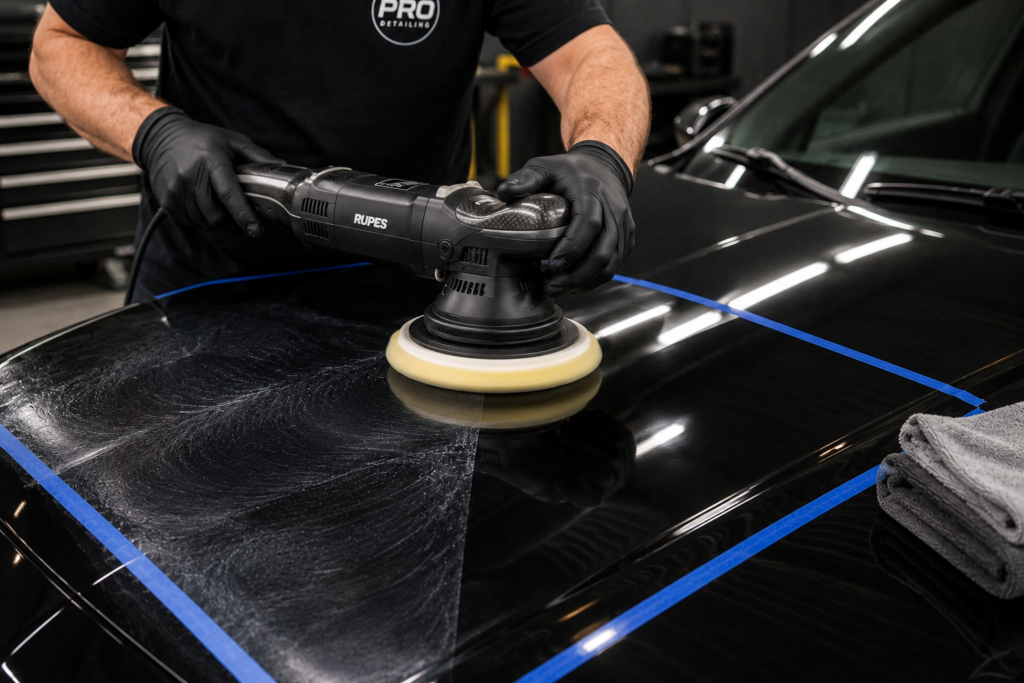
Across owner feedback and professional comparisons, 21mm long-throw polishers stand out for one reason:
speed. The larger throw covers more paint with each pass, making them a strong fit for hoods, roofs, and
doors, where they remove defects faster while still delivering a refined finish. They do call for a bit
more technique than a standard 8mm or 15mm machine, especially around tight curves, but for anyone tackling
a full paint correction, a quality 21mm DA is one of the biggest productivity upgrades available.
👉 Check current price: 21mm long-throw polisher
Best budget under $100 — entry-level DA (Avid Power / SPTA)
You don't need to spend $300 to learn. A sub-$100 DA is a perfectly good way to find out whether you enjoy
paint correction before committing. You'll feel more vibration and lose pad rotation more easily under
pressure, but the fundamentals you learn transfer to any machine.
- Throw: typically 8mm
- Best for: testing the waters on a tight budget
- Why it wins: low risk to try the hobby.
- Watch-outs: more vibration, weaker under load — treat it as a learner you'll likely upgrade.
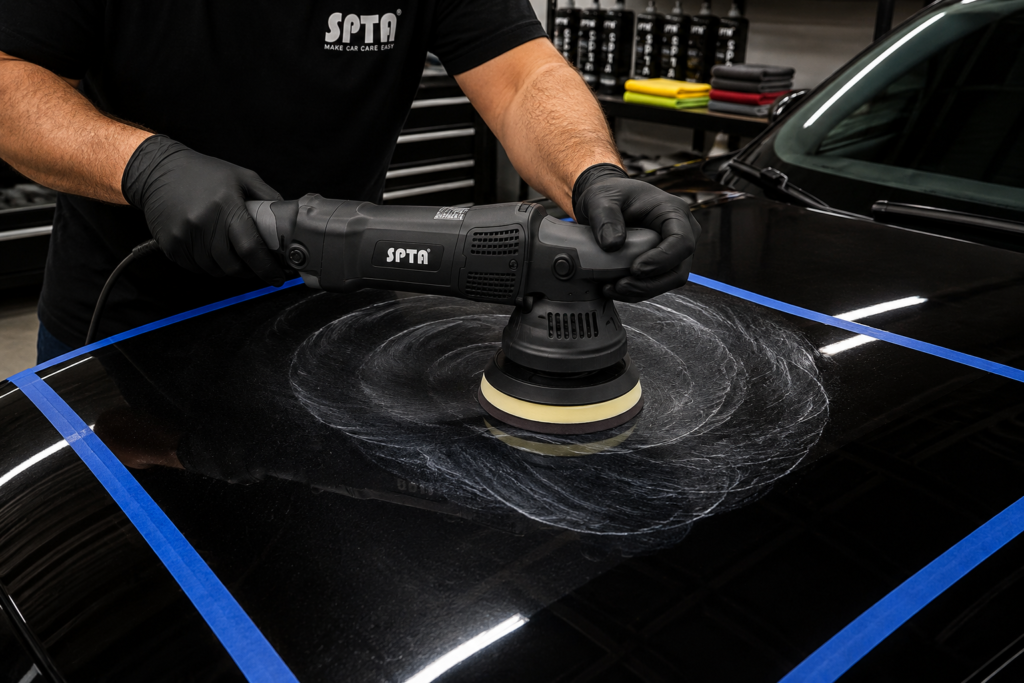
Comparing long-term owner feedback and independent reviews, budget dual-action polishers offer real value
for beginners. They tend to produce more vibration, feel less refined, and correct paint more slowly than
premium machines, but they can still remove light to moderate swirl marks when paired with the right pad,
polish, and technique. If you're just getting started and don't want to spend several hundred dollars up
front, a quality budget DA is a practical way to learn machine polishing while getting results well beyond
what's possible by hand.
👉 Check current price: Budget DA polisher
Comparison at a glance
| Model | Throw | Weight | Best for | Price tier |
|---|---|---|---|---|
| Griot's Garage G9 | 15mm | ~5 lb | Best overall / lasts | $$$ |
| Meguiar's MT300 | 8mm | ~3.7 lb | Best value | $$ |
| Chemical Guys TORQX Kit | 8mm | ~5 lb | Complete starter kit | $$ |
| 21mm long-throw (G21 / LHR21) | 21mm | ~5–6 lb | Large vehicles | $$$ |
| Budget DA (Avid Power / SPTA) | 8mm | ~4 lb | Testing the waters | $ |
Verify current specs and prices before publishing; add an “our rating” column once you've tested each one.
How to choose your throw
Since throw is the number that trips people up, here's the plain version:
- 8mm (short throw): the most controllable and the most forgiving. Slower cut, but you almost can't get
in trouble. Great on tight, curvy panels and for nervous first-timers. - 15mm (medium throw): the all-rounder. Enough cut to remove real swirls at a reasonable pace, still
very manageable. If you're buying one machine, buy this. - 21mm (long throw): fastest coverage, best for big flat panels and larger vehicles. A bit unwieldy in
tight spots — better as a second machine or once your technique is solid.
Rule of thumb: small car + first machine → 15mm (or 8mm if you want maximum peace of mind). Big
vehicle or need for speed → 21mm.
What else you need to start
The polisher is only one third of the equation. To actually correct paint you also need:
- Pads — a cutting pad (removes defects) and a polishing/finishing pad (refines the gloss). Foam is the
easiest to learn on. - Compound and polish — the compound does the cutting; the polish finishes it down. Many beginners
start with a good all-in-one. - The basics of technique — priming the pad, working in small sections, and letting the machine do the
work.
Don't buy the machine and skip these — a great polisher with the wrong pad-and-compound pairing will
frustrate you. For the full walkthrough, read our companion guide:
How to Use a Dual Action Polisher Step by Step.
Keeping your polisher in good shape
A DA polisher is a simple machine, but a few habits keep it running smoothly for years instead of months:
- Check the backing plate for wear every few sessions — it's the part that flexes most and is cheap to
replace compared to the machine itself. - Wipe down the body and cord after each use, especially if you've been spraying compound or working
near a hose. Product buildup around the trigger and vents is the most common cause of a sticky trigger. - Store it flat or hanging, not with a pad still attached. A pad left clamped for weeks can develop a
set that throws off balance slightly. - Don't run it dry against the panel to “test” it. Always have product on the pad — dry-spinning against
paint, even briefly, is one of the few ways to actually mar a panel with a DA.
None of this is complicated, but it's the difference between a polisher that still runs true in year three
and one that starts vibrating oddly after a season of correction work.
First-time polishing mistakes to avoid
These are the errors that make beginners think polishing “doesn't work.” Avoid all five and your first
session will actually be fun.
- Starting on the roof or hood. Start on a lower door panel where mistakes are less visible until you
find your rhythm. - Too much pressure. Let the weight of the machine do the work. Leaning in stalls the pad and adds
heat. - Working too big an area. Stick to roughly 2×2 ft (60×60 cm) sections so the product works
evenly. - Not priming the pad. A dry pad skips and streaks. Spread the product at low speed first.
- Chasing perfection in one pass. Correction is layered. Evaluate, then decide if you need a second
pass — don't hammer one spot.
If swirl marks are your specific enemy, we break down the fix step by step in
How to Remove Swirl Marks.
FAQ
Can a dual action polisher damage my paint?
It's very hard to. Because the pad stops rotating under heavy pressure and the head keeps moving, a DA
spreads heat instead of concentrating it. As long as you don't linger in one spot at high speed with an
aggressive pad, a beginner is extremely unlikely to burn paint with a DA.
What's the best DA polisher throw for a beginner?
A 15mm throw is the best all-around choice — enough cut to remove defects, enough control to stay safe.
If you want maximum peace of mind or mostly work tight, curvy panels, an 8mm short-throw is even more
forgiving.
Do I need an expensive polisher to get good results?
No. Technique matters more than price. A sub-$100 DA can teach you the fundamentals; you can always upgrade
once you know you enjoy the hobby. That said, machines like the MT300 and G9 hold pad rotation better under
load, which makes learning easier.
How long does it take to polish a whole car?
For a beginner, plan on a full day for a single-stage correction on an average car — often 6–10 hours
including washing, decontamination, and cleanup. You'll get much faster with practice.
Can I use a dual action polisher to apply wax or sealant too?
Yes. On a low speed with a soft finishing or applicator pad, a DA applies wax, sealant, and glaze evenly
with far less effort than by hand. It's one of the most underrated uses of the machine.
Is a corded or cordless DA polisher better for a beginner?
Corded machines are generally lighter and don't lose power as the session goes on, which is one less
variable while you're learning technique. Cordless models add convenience (no cord to snag on mirrors) at
the cost of weight and a battery that can fade mid-session — worth considering once you already know how
you like to work.
The bottom line
For most beginners, buy the Griot's Garage G9 if the budget allows — it's the one machine you won't
outgrow. If you want to spend less, the Meguiar's MT300 is the smart-value pick, and the Chemical
Guys TORQX kit is the easiest way in if you'd rather have everything matched for you. Driving something
big? Go 21mm. Just testing the waters? A sub-$100 DA will teach you plenty.
Whatever you choose, remember the machine is the safe part — control comes from technique. Once your
polisher arrives, start with our
How to Use a Dual Action Polisher guide, and if
you're brand new to all of this, begin with the fundamentals in
Car Detailing for Beginners.